• Skip to main content
  • Skip to footer

Craving Change®

A licensed, cognitive-behavioural program for emotional eating.

  • Craving Change
  • For Clinicians
  • For Managers
  • For the Public
  • For Parents and Educators
  • About
    • Our Company
    • The Cognitive-Behavioural Model
  • What’s New
  • Reviews
  • Find a Clinician
  • Stories
  • 4Kids Book
  • Buy Now
  • FAQ
  • Login
  • Refer and Save

I’m a Clinician

 
Tools and training to
transform your practice

Licensee Login If you already have a Clinician License and would like to login to access the Resource Library or order more products, please click below, or “Login” at the top of the screen.


Ready to scale your business with groups?
Tired of writing all of your own client resources and programs?

Craving Change® provides you with everything you need to run programs that address the complexities of emotional eating. Incorporate a cognitive-behavioral framework, activities, and strategies into your individual and group practice, in-person and online. Developed by a clinical psychologist and registered dietitian, this program has transformed the practice of dietetics in Canada for over a decade. Over 3000 dietitians in Canada are licensed Craving Change clinicians.

Craving Change does not give dietary advice nor is it psychotherapy. It is designed to be used by a variety of regulated health care professionals in a wide range of settings, including multidisciplinary health care clinics, private practice, and corporate.

Click to download a copy of the Craving Change One Sheet.

Framework of the Program

The full program is approximately 6 hours of facilitated, sequenced curriculum that covers the topics outlined below. Based on your role, setting, and clients’ needs, you may teach the full curriculum or parts of the program. The program concepts and resources have also been adapted for individual counselling. 

  1. Why it’s Hard to Change – examine the influence of environmental, biological, and learning factors on eating.
  2. What Needs Changing – build awareness of personal eating triggers.
  3. How to Change – provide a menu of cognitive-behavioral techniques and skills.
  4. Keep the Change – teach evidence-based strategies for sustaining new health behaviours

Improved Eating Self-efficacy

Thousands of clinicians have collected and shared client feedback. Clients have overwhelmingly reported:

  • Surprising discoveries about why they eat.
  • Feeling reassured that they ‘are not alone’ with their struggles.
  • An appreciation for the wide choice of practical change strategies.
  • Improved management of their food cravings and emotional eating using personally relevant tools and skills.
  • Decreased guilt and shame with their eating.

“Craving Change gives depth to my practice and client experience.”

Kristyn Hall, RD – Energize Nutrition

Become a Certified Craving Change® Clinician
CC certification badgeExpand your practice and address the needs of your clients in 3 steps.

  1. Purchase a Complete Facilitator’s Kit*– includes a three-year license and is shipped to your door.
  2. Complete the online training and certification exam – takes ~10 hours.
  3. Start using the tools and techniques! – with individual clients or group workshops, online or in-person.

*Cost: $595 CAD/USD/AUD/NZD Plus shipping & handling             

(*Plus applicable sales tax for Canadian orders)

“Craving Change is very useful during these stressful times when food has become the one reliable and affordable companion and comfort in this pandemic.”

Linda Akuamoa-Boateng, RD, CDE,
Rexdale Community Health Centre, Etobicoke, ON

Craving Change Products Complete Facilitator's Kit

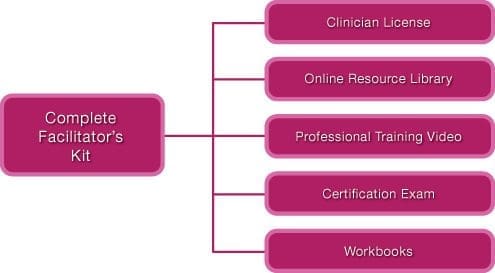
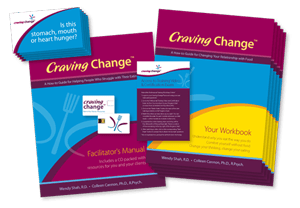
The Complete Facilitator’s Kit is the “starter pack” for Craving Change products. It includes everything clinicians need to become knowledgeable, trained, certified and well-equipped with countless tools.

If you already have a license and would like to purchase additional products, please click on “Login” at the top of the page.
 
Complete Facilitator's Kit

Complete Facilitator's KitThe Kit includes:

  • A Clinician License
  • Facilitator’s Manual
  • Access to the Professional Training Video
  • Access to the Certification Exam
  • 10 Client Workbooks – English

Cost**: $595.00 CAD/USD/AUD/NZD Plus shipping & handling (and applicable sales tax for Canadian orders).

Contact Us for Details

Note: The Craving Change materials are currently written in ‘Canadian’ versus ‘American’ English therefore there are certain spelling differences.
Clinician License

To use the program and resources, you must have a Clinician License and complete the certification process. The three-year Clinician License 2021 is included with the Complete Facilitator’s Kit. Terms include: 

  1. Permission to be used with individuals and small groups when certification is complete. (12 per virtual group and 20 in-person).
  2. Standard restrictions to protect the confidentiality of the intellectual property, the trademark and program fidelity.
  3. No royalty fees.

Certification with Craving Change Inc. is mandatory for all clinicians who purchased their license as of May 1, 2021. Certification takes approximately 10 hours and involves three steps: 

  1. Become familiar with the Facilitator’s Kit
  2. Review the online training videos
  3. Complete the certification exam

To continue to use the program and resources at the end of the three-year term, the license and certification must be renewed. The cost is $95 and online re-certification takes about 2-3 hours.*

*Clinicians licensed prior to May 1, 2021 are not required to be certified or renew their license. They may only teach small group online Craving Change workshops if they sign a Memorandum of Understanding with Craving Change Inc. agreeing to certain requirements.

Facilitator's Manual and Resource Library

Facilitator's ManualThe Craving Change signature product for over 15 years! The manual includes background information, interactive session guides, activities and facilitation tips. The material can be used to lead a Craving Change workshop series, as a supplement to a pre-existing group program, in individual counselling sessions or simply as a helpful, accessible resource for health care professionals. The sturdy, coil-bound, user-friendly manual includes:

  • Step-by-step instructions for facilitating your own Craving Change workshops.
  • Behaviour modification and cognitive-behavioural strategies translated into engaging activities and lively discussion topics for groups and individuals.
  • Facilitation notes, suggested scripts and background information to help you prepare for and present the workshops.
  • Guidelines and tips to make group facilitation less intimidating.
  • Suggestions for facilitating program follow-up sessions.

Find out more about the four components of the Craving Change workshop series:

  • Program Description

Browse through the Facilitator’s Manual – six selected sample pages.

  1. The Balancing Act of a Craving Change Facilitator
  2. Types of Hunger
  3. Consider the Circumstances
  4. Triggers and Learned Response – Review
  5. Quit Sabotaging Yourself
  6. Slipping Toward Success

Craving Change licensees can log into the online Resource Library. The Library is loaded with new references, facilitation tools, activity guides and 38 supplemental resources that can be used to refresh and enhance your workshops, follow up groups, and individual counselling.

Browsing through the Resource Library is also like getting a pass to go behind the scenes of a movie set or theatre. Here’s where you’ll find the nuts and bolts for facilitating the workshop series, as well as the foundation for the program.

Behind the Scenes Resources include:

  • Organizational details and presentation tips for facilitating the Craving Change workshop
  • The One on One individual counselling guide and the ABC’s of CBT document
  • Promotional poster
  • A large selection of stand-alone worksheets from the Client Workbook that you can print for your individual clients
  • Ready-to-use PowerPoint slides
  • Evaluation forms

Take a peek behind the curtain of Craving Change – selected excerpts from the ‘Behind the Scenes’ Resource Library content.

  • Director’s Notes
  • The Acts
  • Powerpoint slide
  • Client evaluation form
  • Promotion poster


Cost: This product is sold along with a Clinic / Organization Package or the Complete Facilitator’s Kit. It is not sold separately.
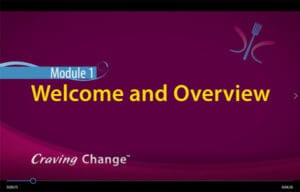
Professional Training Video

Professional Training VideoReview of the training videos and completion of the certification exam takes approximately 10 hours.

The online training video workshop is based on 25 very well-received professional training workshops that the authors of the program taught across Canada over several years. The nine modules cover core elements of Craving Change including the framework of the program, scope of practice considerations, and a review of key facilitation reminders. The authors demonstrate the program activities and share their tips and expertise. Access is provided for 120 days from the date of purchase. Check out what you can expect as you go through the nine modules.

  • Outline of video modules from Training Video package
  • Watch a sample of the Module #1 video

Each video module is followed by a number of questions and assignments that make up the online certification exam. You will have 120 days to access this exam from the date of purchase.

Cost: This video is available as a key component of the Complete Facilitator’s Kit. It is not sold separately.

Certification Exam

Review of the training videos and completion of the certification exam takes approximately 10 hours. You will have 120 days to access this exam from the date of purchase. The exam consists of:

  • 105 scored multiple choice questions Exam
  • Six case studies that encourage critical thinking as you apply the Craving Change approach with individual client scenarios.
  • 18 ‘personal application’ suggestions for incorporating the Craving Change concepts into your professional practice and personal life.
  • A Final Experiential Assignment that encourages you to assess your ability to use the Craving Change tools, activities or approach in a real life situation. The assignment is submitted online.
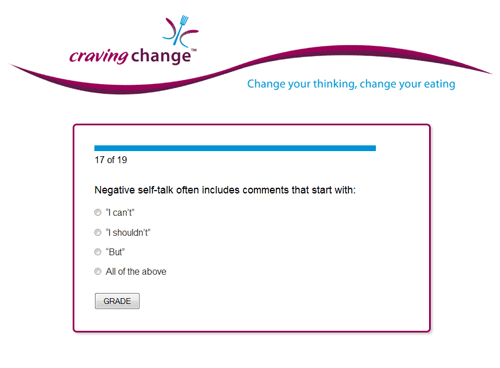
Your certificate of completion will be emailed to you when you have submitted and passed the certification exam. Certification is valid for 3 years, at which time recertification for another 3 years is required when you renew your license if you wish to continue using any of the materials in your practice.
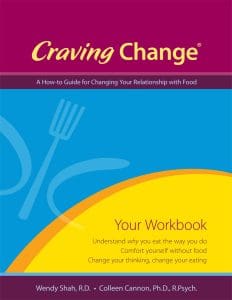
Client Workbooks

Client WorkbooksThe Craving Change Workbook is an invaluable resource for your individual clients or workshop attendees. Nearly 100,000 workbooks have been sold to date in Canada! The 64-page, soft-cover book makes the cognitive-behavioural approach straightforward and accessible for clients. It is NOT a boring or overwhelming ‘patient education resource’. This workbook turns clients ‘on’ instead of ‘off’!

Unanimous feedback clearly indicates that this resource augments what clients learn from the Craving Change approach and they literally ‘bring home’ the concepts. Clients actively note their observations, complete personal worksheets and follow step-by-step instructions for cognitive and behaviour change and continually refer back to this popular resource.

Check out the content and style of the Workbook – six selected sample pages.

  1. You Are Not Alone
  2. Types of Hunger
  3. The Change Buffet
  4. Adopt an 80/20 Mindset
  5. Improving your Self-talk
  6. Keep the Change

Once you’re licensed with Craving Change Inc. you can order more workbooks for your group workshops and for individual clients.

Cost*: Order your workbooks in bulk. You SAVE over 15% when you purchase a package of 50 workbooks.

  • 10 Workbooks: $75.00 
  • 25 Workbooks: $175.00 
  • 50 Workbooks: $315.00  

* Plus shipping & handling and applicable sales tax for Canadian orders. 

“I recently ran a Craving Change program by Zoom. It went really well and there was great group interaction. We had 100% attendance for all 4 sessions! I feel Craving Change has helped me in all aspects of communication with patients. Specifically, changing patients’ negative thoughts on their health conditions to a more positive outlook.”

Kimberly Gordon-Krushell, a Primary Care Network community nurse


CC certification badge Recertification

The Clinician License and certification are valid for three years at which time license renewal and successful completion of an online 35 multiple choice question re-certification exam is required. The cost to re-certify is $95. The expiry date of the license and certification will be noted on the initial certificate and a reminder email will be sent. Clinicians who do not recertify are no longer licensed to use any Craving Change materials or resources in their practice.

Please note that clinicians licensed between 2008 and 2020 were “strongly encouraged” to maintain current certification. New clinicians licensed beginning May 1, 2021 are required to maintain current certification as a condition of the license.

When clinicians renew their license and recertify, they receive:

  • A certificate with Craving Change Inc. and use of the certification badge for another three years.
  • Continued password-protected, online admission to the ever-growing Resource Library.
  • Free self-promotion on the Craving Change website for the public and other health care providers.
  • A discount of 15% on all workbook orders for the duration of your re-certification – this is a savings of up to $44.25 per order!

“I often use a cognitive-behavioural approach to set aside self-judgment and explore unhelpful thoughts to improve emotions and change self-sabotaging behaviours. The Craving Change program is comprehensive and well organized. I appreciate that we can adjust the information according to the ‘micro-culture’ of the group.”

Denise McClure, social worker with Horizon Health in New Brunswick


FAQs

What does a 'cognitive-behavioural framework' mean?

The cognitive-behavioural model is an approach to understanding well-being and behaviour that has received strong support in research for decades. The model looks at how ‘internal’ events such as thoughts and feelings, affect behaviour. All three of these core elements strongly impact one-another. Interventions based on this model have been demonstrated as effective across a wide range of psychological difficulties including eating disorders, depression, and anxiety. This model has also been well supported by research for interventions that are relatively short-term, and interventions that are offered in either individual or group modalities. Please click here for more information.

Is Craving Change a weight loss program?

No. Research has clearly demonstrated that the most effective weight loss programs include information about a healthy, reduced energy intake and increased physical activity. Craving Change does not include these components.

However, including behaviour modification and cognitive behavioural techniques similar to those used in Craving Change has been shown to enhance weight loss and long-term weight maintenance when combined with weight-loss regimens. What’s been missing from this research is clear direction about what specific techniques should be taught, who should teach them, and standardized materials with certified facilitators. Craving Change Inc. provides a clear response to this overwhelming need.

Is the Craving Change program a treatment for eating disorders?

No. The program is not a treatment for someone diagnosed with an eating disorder. While many of the techniques used in the program are similar to those found in eating disorder treatment programs, such treatment requires extensive professional training and significant interdisciplinary collaboration. Craving Change Inc. does not provide that training.

However, there are a significant number of people who are in distress about their eating habits, yet do not meet diagnostic criteria for an eating disorder. Craving Change is an ideal intervention for many of these people.

What is stepped care?

Demand for specialized psychosocial services for those who struggle with their eating far outstrips available resources. Several authors have suggested a stepped-care approach as a strategy to address this crisis. The stepped-care approach asserts that a significant number of people will benefit from a general intervention provided by educated professionals who are not necessarily experts in problematic eating. Clients who are identified as requiring more intensive individualized services at the end of the intervention are then encouraged to follow up with additional specialized resources.

Craving Change is an appropriate program for this initial step as a general intervention.


License FAQs

Do I need to buy a license to use the materials?

Yes. Craving Change is a licensed and trademarked program. Anyone wishing to own or use the materials must purchase a license. Clinician, organization, and corporate licenses are available. 

I work with two other clinicians and we're all interested in using the materials in our practice. Do we have to buy three licenses?

Yes. You can either purchase 3 Complete Facilitator’s Kits, or your organization can purchase a Clinic / Organization License for use by up to 15 , 25, or 50 clinicians.

Please click here for more information about the best fit for you.

An Organization license includes the use of materials for a three-year term that stays with the organization regardless of staff turnover and is renewable for another 3 years at 50% off the original price.

Which type of license should our organization purchase?
  1. I work at a diabetes clinic and I want to offer Craving Change workshops to my clients. The Clinician License permits you to use Craving Change materials with your patients, in both individual and small in-person groups (under 20 clients) settings. Should you leave your job or start working in another setting such as private practice you are still entitled to use the Craving Change materials as this license is an agreement between you and Craving Change Inc.
  2. I want all of my staff to understand the basic concepts in Craving Change and be able to describe it to clients. I want about 16 clinicians to get trained and start implementing the program, but then later this year there are about 5 other clinicians that I’m going to want to train. We intend to use your logo on our website – we want to affiliate ourselves with the brand of the #1 cognitive-behavioural program for problematic eating in Canada! How do I deal with staff turnover? The Organization License was designed with you in mind! 
  3. I have 3 colleagues at my clinic who also want to use Craving Change materials with our clients. You have a choice – either each of you can purchase a Complete Facilitator’s Kit OR your clinic could purchase an Organization License Package. While the Organization License involves a higher up-front fee, there are numerous additional benefits for the clinic. If you move on from your job at this clinic you would need to forfeit your materials back to the clinic and purchase your own individual license to use in your new setting.
  4. I am the owner of a private weight management clinic (or pharmacy chain, surgical clinic, wellness clinic, physiotherapy clinic, insurance provider, etc). The clinic is a “for-profit” business and aligning with Craving Change Inc. could really increase our profile and attract more customers. We have ads in the paper and on the web or TV. A License is required – and we’d love to work with you! Aligning your company with the Craving Change brand and logo could give you that competitive edge you’re looking for. The cost for this relationship depends on many factors, including the size and “reach” of your company and the extent of consultation services you’d like from us. Please contact Craving Change Inc. at info@cravingchange.ca for more information.
 

Training FAQs

Who is eligible for a Craving Change license?

Craving Change is a skills-based psychoeducational program that uses self-awareness tools and guided discussions. The program explores sensitive personal questions and the somewhat controversial topic of healthy eating behaviours. It is important that licensees have been trained in facilitation and counselling skills consistent with the requirements of their profession.

The program does not give dietary advice, it is not psychotherapy, and it does not provide education on specific health conditions such as diabetes. Licensees must be knowledgeable and diligent about their profession’s scope of practice when using the Craving Change approach and resources.

You are eligible for a Craving Change license if you meet one of the following criteria:

  1. You are registered with a professional regulatory body as a health professional. Registered health professionals belong to Colleges included under the Regulated Health Professions Act in their province or state. =Examples include registered dietitians, registered nurses, psychologists, licensed social workers, and physicians.
  2. You are a professional licensed counsellor and hold professional liability insurance. Professional licensed counsellors include professionals certified with a regulatory body such as the Canadian Counselling and Psychotherapy Association. The degree granting institution must be recognized and accredited by the government.
  3. You are a Professional Life Coach certified through one of the following professional organizations and you hold professional liability insurance.
  • International Coaching Federation (ICF) – Associate Certified Coach (ACC), Professional Certified Coach (PCC), or Master Certified Coach (MCC) certified and an active member. Please note, attending an ICF course does not qualify you for licensing.
  • Association for Coaching (full members only).
  • Board Certified Coach (BCC) through the Center for Credentialing and Education (CCE).
Do I need to be a therapist to use cognitive-behavioural techniques?

No. A wide range of regulated professionals can use techniques born from a cognitive-behavioural framework in their work with their clients, IF they work within their scope of practice and remain vigilant to the limits of their competence.

For example, there is a considerable difference between teaching a group how to reframe repetitive negative thoughts into more positive or realistic thoughts, versus probing a group to think about the roots of their negative thinking and uncover core beliefs. The former is appropriate in Craving Change, the latter is not. Craving Change does NOT give you license to “dig deeper” into your clients’ very personal thoughts and feelings and the roots of those thoughts and feelings. However, it does teach you to teach your clients how to become more aware of thoughts and emotions that might be triggering problematic eating.

The Craving Change Facilitator’s Kit attempts to outline this distinction several times throughout the program, and very specific guidelines are given for the group discussions to responsibly contain group discussions.That being said, if you are a registered psychologist or social worker trained in providing psychotherapy, feel free to incorporate Craving Change materials into a psychotherapeutic program as you see fit.

Facilitators are encouraged to be knowledgeable about local and online resources, as it is common for participants to decide at the end of the program that they’d like to follow up what they learned about their relationship with food on a “deeper” and more personal level. For instance, therapy to address marital difficulties, stress, anxiety or mood difficulties. We’ve received consistent feedback that when these people attend therapy they are ready to “hit the ground running” as their self-awareness and familiarity with the cognitive-behavioural model has already taken hold. This is an excellent example of stepped care service delivery in action!

Can we purchase and use the online Professional Training Video as a group?

Each person wishing to watch the video must have purchased online access and will receive a login. An Organization license provides access to the video for a certain number of staff over the three-year period of the license. Staff could go through the video together however each individual clinician will still require a login (included in the cost of the Organization license) should they wish to write and submit the certification exam.


Certification FAQs

I have a Clinician License, but have never certified? What are the advantages of becoming certified now?

Clinicians licensed from 2008-2020 were “strongly encouraged” to become certified and maintain current certification, however certification was not mandatory. As of May 1, 2021, it is a condition of the license with Craving Change that the clinician complete and maintain their certification, renewing their certification every three years. Original Clinician License holders who never certified will not be eligible for the benefits of certification including the permission to offer online group workshops, workbook discounts, and the option of listing their practice on our Find A Clinician page. Contact our License and Resource Manager at orders@cravingchange.ca to find out how to get certified or renew expired certification. 

Do I need to maintain current certification in order to teach group online workshops?

Yes, current certification is mandatory for all clinicians teaching virtual workshops. 

How long is the certification valid? How do I re-certify?

Certification is valid for 3 years. Shortly prior to expiry, you will receive an email prompting you to recertify. To renew for an additional 3 years (4-6 years since the initial Kit and license purchase) and to renew for a second 3 years (7-9 years since Kit and license purchase) costs $95 each time and includes the cost of license renewal for 3 years. The recertification exams include multiple choice and short answer questions and take about two hours to complete. Renewal for 10-12 years only requires completion of short answer questions and a fee of $95. Recertification is free for clinicians licensed under an Organization or Corporate License.

Any questions about your current certification status can be directed to Kim, our License and Resource Manager at orders@cravingchange.ca. 

Intellectual Property and Trademark FAQs

Can I use your logo on my website?

Only organizations with Organization Licenses, or businesses with a Corporate License may use the Craving Change Inc logo on their website.  

Please see the Brand and Trademark Guidelines for more information.

I love the name! Can I use it in my practice?

The details of how the name “Craving Change” may be used are contained in the clinician license.

In short, if you wish to incorporate some of the materials from your Facilitator’s Kit into your existing program you are welcome to do so, but you may not call your entire program “Craving Change” as it is a trademarked name. If you run a workshop program as written and outlined in the Facilitator’s Kit, please call your program “Craving Change®“.

Can I translate the program into a different language?

In short, no.  The translation of any of the Craving Change resources into another format or another language is considered a derivative work. A derivative work is a new, original product that includes aspects of a pre-existing, copyrighted work. As the owner of the intellectual property, by law, permission from Craving Change Inc. to produce a derivative work is required.

Can I charge for the workshops? How much?

Yes, you may charge for the workshop or you may offer it free. We do not collect royalty fees for individual clinicians or organizations. Some settings just use Craving Change materials as reference materials, some offer full programs at no charge or a minimal charge to recover costs, and some clinicians are offering full programs in private practice for full fee – these are all great applications of the materials – how much you charge is up to your discretion.

Here is what some other clinicians and organizations have charged per client:

  • $7.00 – to cover the cost of the workbook for the client
  • $10.00 – $45.00 – to cover the cost of the workbook and the venue rental
  • $10.00 – $300.00 – private practice health care provider

Resources FAQs

Why is the Facilitator's Kit written in a workshop format?

Because group work, works! Please note that the resources included in your Complete Facilitator’s Kit include a 32-page Individual Counselling Guide with countless suggestions for incorporating the mindset and materials of Craving Change into your 1:1 clinical practice.  Some of the advantages to offering the Craving Change program in a group format include:

  • Time and cost-saving benefits
  • Group synergy, support, and energy
  • Drawing on the knowledge and expertise of group participants
  • Normalization of problematic eating
  • Increases participants’ self-efficacy
What does a Craving Change workshop actually look like?

We recommend 8-20 participants as an ideal size for a Craving Change workshop, 12 for an online workshop. The material takes approximately 8 hours to facilitate, that we recommend breaking down into 3, 4, or 6 sessions. The Facilitator’s Manual is written as though you are facilitating the program over 3 sessions, and suggestions for changing the format to a 4 or 6-session workshop are provided on the USB wafer. You are encouraged to adjust the format as needed to meet your own or your organization’s needs.

The workshop uses a variety of techniques, including guided, interactive discussions, brainstorming activities, brief written exercises, and homework tasks. We strongly encourage a relaxed atmosphere with no “lecture” component. Materials spanning the entire workshop are prepared for you as power point slides. The slides provide very brief information and should be used sparingly, with the focus instead being on thought-provoking, relaxed group discussion.

Participants should receive either their own copy of the client Workbook, or stand-alone worksheets from the USB wafer or online Resource Library.

What's the difference between the Client Workbook and the worksheets?

The client Workbook is a resource that can be purchased for your clients. It is a bound booklet with a colour cover available at a cost we’ve strived to make as accessible as possible for you and your clients (about 7 dollars each plus shipping and handling). Over 50, 000 of these workbooks have been sold across Canada with overwhelmingly positive feedback.

The client Workbook can be used as a supplement in your work with individual clients or in Craving Change workshops. Please note that copying any information out of the Client Workbook is strictly prohibited by law. If you want to use materials from this resource with your clients, you must purchase copies of the workbook for your practice.

The workbook is designed to be a helpful resource for your clients while you’re working with them. It can also be a handy reference to refer back to for years to come. If you’re working with groups, we believe that each participant will get the most benefit from the program if they have their own copy of the client Workbook. The client Workbook includes:

  • Key messages from the program.
  • Activity and self-awareness worksheets.
  • A how-to guide outlining how to apply more than a dozen different strategies for changing problematic eating.
  • Short personal stories from people who have shared their struggles with food.

If purchasing Client Workbooks is not an option for you or your organization, or you only wish to “pick and choose” from various Craving Change activities and strategies, the stand-alone worksheets may be the answer for you. Many stand-alone worksheets spanning various components of the program are available on the Resource USB wafer in the Facilitator’s Kit and in the online Resource Library. New worksheets that supplement the program and your individual counselling resources are added to the Resource Library every year. You are free to reproduce these worksheets for your clients. All other materials on the USB wafer are protected by copyright and may not be reproduced in any format.

Can I buy a copy of the materials and photocopy them for my clients and colleagues?

The Resource USB wafer includes 19 stand-alone worksheets plus evaluation forms that you are welcome to print and distribute to your clients. Many more are included in the online Resource Library for certified clinicians.

Under the conditions of the license agreement, you are not permitted to share these forms with your colleagues – they need their own license agreement to use the materials.

The Facilitator’s Manual, client Workbook, and workshop organization and facilitation tips on the Resource USB wafer are protected under copyright law and must not be copied or reproduced in any manner.

How can I offer long-term follow-up for clients who have attended the workshop?

Great idea! Follow-up sessions can be very helpful in the change process and many clinicians across Canada are now offering them to graduates of their Craving Change programs. Clients love to meet up after completing a Craving Change workshop to share their successes, ideas, and their frustrations. There is a document included in the resource materials entitled ‘Keep the Change Going’ that provides direction for using content already in your Facilitator’s Manual to lead follow-up sessions. The Resource Library also includes extra activities and worksheets that are ideal for follow-up sessions in groups or with individual clients.

Can we use the Craving Change approach with children and teens?

The Craving Change program per se has not been validated with this unique population, and neither author is a youth specialist.

However, several clinicians in Canada have used some of the core concepts in Craving Change, including introducing the concept of eating triggers and selected cognitive-behavioural techniques with this age group. Of course, children and youth are actively developing an important relationship with food. There are many Craving Change guided discussions, activities and techniques that could be used with children and teens. Please email us if you would like more information.

Research / Outcomes FAQs

Can you direct me to some evidence that backs up the Craving Change approach?

Three sites using Craving Change® recently shared their outcome data with us. An urban Primary Care Team in Alberta (N= 197), and a Family Health Team in Ontario (N = 52, data collected at both an urban and rural site). We are very grateful for their generosity and applaud their hard work – the challenges of collecting data in clinical settings are well-documented.  You can see a summary of their results by downloading Roots and Outcomes

As in the 2010 Eating Behaviors von Ranson et al published study, statistically significant improvements in eating self-efficacy were demonstrated from both sets of results. To quote one site’s summary, “after attending the Craving Change program, most participants are better able to control eating in both Socially Acceptable and Negative Affect scenarios, and these benefits are sustained over time.” (6 months follow up). Engagement/retention rates are also notable, with one site quoting 70% attendance at least 3 of 4 classes, and the second site (which offered the program over 3 classes) reporting 73% complete attendance.

Clinical practice guidelines for obesity and chronic disease management in several countries recommend the incorporation of behavioural and cognitive strategies into patient care. For instance, Canada, Australia, the UK, and the USA.

Here’s an abridged list of published data highlighting the logic and evidence underlying the Craving Change curriculum:

  • Affenito SG, Backstrand, JR, Welch, GW, Lammi-Keefe, CJ, Rodriguez, NR, & Adams, CH. Subclinical and clinical eating disorders in IDDM negatively affect metabolic control. Diabetes Care. 1997; 20: 182-184.
  • Byrne, SM, Cooper, Z, & Fairburn, CG. Psychological predictors of weight regain in obesity. Behavior Research and Therapy. 2004; 42: 1341-1356.
  • Canadian Diabetes Association 2008 clinical practice guidelines for the prevention and management of diabetes in Canada. Canadian Journal of Diabetes. 2008; 32: Supplement 1.
  • Devlin, MJ, Yanovski, SZ, & Wilson, GT. Obesity: What mental health professionals need to know. Am J Psychiatry. 2000; 157: 854-866.
  • Ellis SH, Speroff T, Dittus RS, Brown A, Pichert JW, & Elasy TA. Diabetes patient education: a meta-analysis and meta-regression. Patient Education and Counselling. 2004; 52: 97-105.
  • Hay, P & Fairburn, CG. The validity of the DSM-IV scheme for classifying bulimic eating disorders. Int J Eat Disord. 1996; 23: 7-15.
  • Hollis, JF, Gullion, CM, Stevens, VJ, Brantley, PJ, Appel, LJ, Ard, JD, Champagne, CM, Dalcin, A, Erlinger, TP, Funk, K, Laferriere, D, Pao-Hwa L, Loria, CM, Samuel-Hodge, C, Vollmer, WM, & Svetkey, LP. Weight loss during the intensive intervention phase of the Weight-Loss Maintenance Trial. Am J Prev Med. 2007; 35: 118-126.
  • Kenardy, J, Mensch, M, Bown, K, Green, B, Walton, J, & Dalton, M. Disordered eating behaviours in women with type 2 diabetes mellitus. Eating Behaviors. 2001; 2: 183-192.
  • Lowe, MR, Gleaves, DH, DiSimone-Weiss, RT, Furgueson, C, Gayda, CA, Kolsky, P, Neal-Walden, T, Nelsen, LA, & McKinney, S. Restraint, dieting, and the continuum model of bulimia nervosa. Journal of Abnormal Psychology. 1996; 105: 508-517.
  • Niemeier, HM, Phelan, S., Fava, JL, & Wing, RR. Internal disinhibition predicts weight regain following weight loss and weight loss maintenance. Obesity. 2007; 15: 2485-2494.
  • O’Rourke, SK, Del Mar, C, & Kenardy, J. Psychological interventions for overweight or obesity. Cochrane Database of Systematic Reviews. 2005; Issue 2 Art. No: CD003818.
  • Rodin G, Olmsted MP, Rydall AC, Maharaj SI, Colton PA, Jones JM, Biancucci LA, & Daneman D. Eating disorders in young women with type 1 diabetes mellitus. Journal of Psychosomatic Research. 2002; 53: 943-949.
  • Scarano, GM, & Kalodner-Martin, CR. A description of the continuum of eating disorders: Implications for intervention and research. Journal of Counselling and Development. 1994; 72: 356-361.
  • Shisslak, CM, Crago, M, & Estes, LS. The spectrum of eating disturbances. Int J Eat Dis. 1995; 18: 209-219.
  • Stahre, L, & Hallstrom, T. A short-term cognitive group treatment program gives substantial weight reduction up to 18 months from the end of treatment. A randomized controlled trial. Eating Weight Disord. 2005; 10: 51-58.
  • Stice, E, Ziemba, C, Margolis, J., & Flick, P. The dual pathway model differentiates bulimics, subclinical bulimics, and controls: testing the continuity hypothesis. Beh Therapy. 1996; 27: 531-549.
  • Sullivan, PF, Buli, CM, & Kendler, KS. The epidemiology and classification of bulimia nervosa. Psychological Medicine. 1998; 28: 599-610.
  • Tylka TL, & Subich, LM. Exploring the construct validity of the eating disorder continuum. Journal of Counselling Psychology. 1999; 46: 268-276.
  • von Ranson, KM, Stevenson, AS, Cannon, CK, & Shah, G.Changes in eating pathology and associated symptoms among chronically ill adults attending a brief psychoeducational group. Eating Behaviors. 2010; 11: 186-189.
  • Wilson, GT, Vitousek, KM, & Loeb, KL. Stepped care treatment for eating disorders. Journal of Consulting and Clinical Psychology. 2000; 68: 564-572.
  • Wing, RR, Marcus, MD, Epstein, LH, Blair, EH, & Burton, LR. Binge eating in obese patients with type II diabetes. Int J Eat Dis. 1989; 8: 671-679.
  • Yager, J. Weighty perspectives: Contemporary challenges in obesity and eating disorders. Am J Psychiatry. 2000; 157: 851-853.
How can I (my organization) measure outcomes for the Craving Change program?

We encourage data collection related to using the Craving Change approach and resources in your practice. Questionnaire selection depends on a number of factors such as availability, budget, length, and most importantly- the variables you are hoping to measure. Self-efficacy is widely considered a significant predictor of behaviour change, and people who attend Craving Change programs have been shown to have higher levels of eating self-efficacy after completing the program. Some questionnaires to consider for your project include:

  1. Eating Disorders Examination- Questionnaire (EDE-Q). 36 items. Fairburn CG & Beglin,, SJ (1994). Assessment of eating disorders: Interview or self-report questionnaire? International Journal of Eating Disorders, vol 16, p 363-370.
  2. Eating Self-Efficacy Scale (ESES). 25 items. Glynn, SM & Ruderman, AJ. (1986). The development and validation of an eating self-efficacy scale. Cognitive Therapy and Research, vol 10, p 403- 420.
  3. State Shame and Guilt Scale (SSGS). 15 items. Marschall DE Sanftner JL, Tangney JP. The State Shame and Guilt Scale. Unpublished manuscript, George Mason University, Fairfax, VA.
  4. Another questionnaire that you may find useful and that is appended at the end of Nolan, Halperin & Geliebeter, 2010, Appetite, vol 54, p 314-319. is the Emotional Appetite Questionnaire. It is available in the public domain for free. The literature review in this paper does a good job of reviewing the emotional eating questionnaires currently available.

We are always grateful when sites share their outcome data with us, please consider contacting us for this purpose. We respect requests for sharing results without site identifiers.

Customer Service FAQs

Can I get my money back if I want to return resources?

No. Purchases of Craving Change written materials are final.

How do I get help if I am having technical problems with the online video or certification exam?

For the individual clinician license holders, online access is available for both the video and the exam for 120 days from the date of purchase. A three-year organization license includes online access for 120 days per clinician from the time of individual clinician registration.

“Being trained in the Craving Change curriculum, I am more confident in the treatment plan for my clients and goals of our sessions. The Craving Change curriculum has given my counselling practice a clear sense of how to facilitate sessions with a client so that they can learn, practice skills and have more of a “brief” action plan in place. It is very effective for clients.”

Jillien Humphrey, SW, Interior Health British Columbia

Craving Change® Book for
Kids and Parents

Is this stomach, mouth or heart hunger?<sup>®</sup>Since 2008, the Craving Change program has been helping adults who struggle to make positive, long-term changes to their eating habits. We now have a resource that addresses our ‘relationship with food’ at an early age.

This delightful, illustrated story follows Moe on a typical day as he discovers that he has three different kinds of ‘hunger’. Click here to see samples pages of the story.

A four-page appendix provides parents and caregivers with an explanation of the simple eating self-awareness technique introduced in the story. The appendix includes suggested responses for each of the three kinds of ‘hunger’. These tips and additional free, downloadable handouts can be used to help your child develop a positive and healthy relationship with food.

Read excerpt from Appendix

Check out a sample of a downloadable handout

This book was written in partnership with the Centre for Healthy Active Living at the Children’s Hospital of Eastern Ontario.

Financial support was provided by the Dietitians of Canada DOC Network.

BOOK DETAILS

Genre: Life Skills for Children

Age: 4 to 10 years

Description:

  • Laminated, 8″ x 8″ soft cover
  • 32 colourfully illustrated pages
  • Includes 4-page appendix for parents and caregivers
  • Provides online access to downloadable resources/ handouts

Also includes stickers!

Price: $11.95 plus GST
Shipping only $2.00 anywhere in Canada!

Buy Now

Buy in bulk and save!
5 books for $50.00 (plus shipping and taxes)


About Our Company

A Canadian business created and owned by registered dietitian Wendy Shah and clinical psychologist Dr. Colleen Cannon, Craving Change Inc. was founded in 2008. The evidence-based program’s licensed materials and online training are available internationally. Over 50,000 Craving Change client workbooks are in distribution. Craving Change Inc. services also include professional speaking and content development for corporate resources such as websites, customer newsletters and apps.

Learn more

About the Co-Founders

Both Wendy Shah, RD and Dr. Colleen Cannon, RPsych. have decades of experience working with people struggling to make and maintain healthy behaviour changes. Wendy has a strong interest in the psychosocial and environmental factors that influence our eating behaviours. She has won national professional awards in consumer communication and public education. Dr. Cannon is passionate about health psychology. She is skilled in systemic problem-solving, program development and making psychological interventions engaging and accessible. She is a member of the Academy for Eating Disorders and was an Adjunct Professor in the University of Calgary Department of Psychology from 2008-2011.

Learn more


Footer

Contact Info

Mailing Address:
Craving Change Inc.
Suite 305
234, 5149 Country Hills Blvd NW
Calgary, Alberta  T3A 5K8 Canada

Connect With Us

Email Us Follow us on Facebook Follow us on Instagram Connect with us on LinkedIn Follow our YouTube Channel

Contact Resource Manager

© 2026 Craving Change®. All rights reserved.  | Privacy Policy | Cookie Policy | Terms & Conditions of Use | Site Map | Web Design


Is this stomach, mouth or heart hunger?

Spark eating behaviour ‘ah-ha’ moments with our most popular tool.

Sign up now for our monthly newsletter for tips, resources and special offers.

No obligation, unsubscribe at any time. We will never share or sell your email address.